Diverse newcomer adults and families in a Canadian city, reflecting changing fertility patterns and family stages.
A new study on Immigrant Fertility in Canada offers a more detailed picture of how newcomers are shaping the country’s population. Researchers found that immigrants still had a higher fertility rate than Canadian-born people in 2021, but the difference had narrowed considerably over two decades.
The findings matter because Canada relies heavily on immigration to support population and labour-force growth. However, the study does not announce a new immigration program or change any application requirement. It is demographic research that may help inform future public-policy discussions.
What the Immigrant Fertility in Canada study found
The peer-reviewed study published in Population Research and Policy Review examined long-form census data from 2001, 2006, 2016 and 2021, together with the 2011 National Household Survey.
The researchers estimated total fertility rates using the “Own Infant Method.” In simple terms, this method links infants living in a census family to their mothers and uses the mothers’ ages and characteristics to estimate fertility during the period before each census.
The principal findings include:
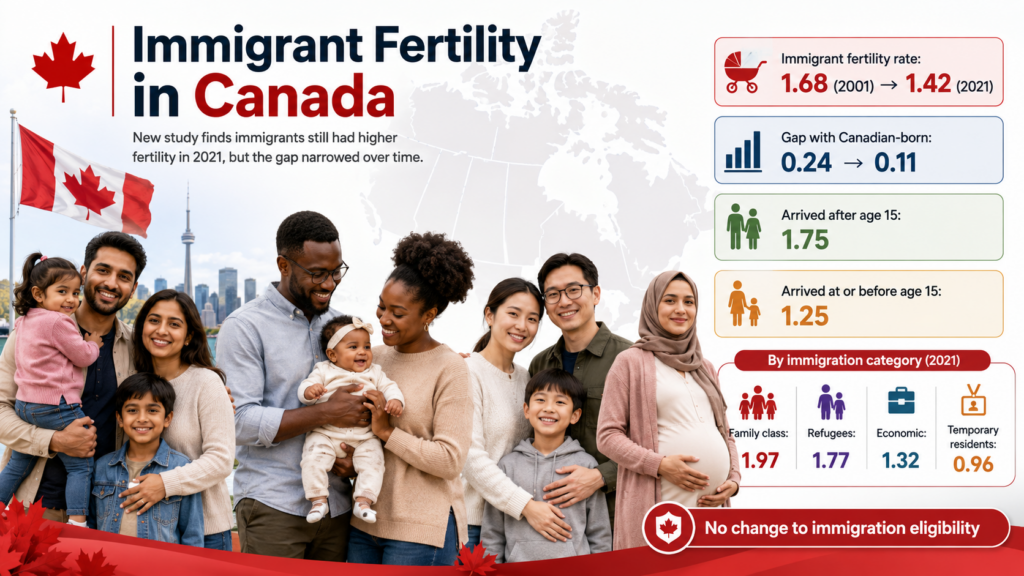
- The estimated fertility rate for immigrants declined from 1.68 births per woman in 2001 to 1.42 in 2021.
- The gap between immigrants and Canadian-born people narrowed from 0.24 births per woman in 2001 to 0.11 in 2021.
- Immigrants who arrived after age 15 had an estimated fertility rate of 1.75 in 2021.
- Those who arrived at or before age 15 had a lower estimated rate—1.25—than both later-arriving immigrants and Canadian-born people.
These figures are study estimates for the period immediately preceding each census. They should not be confused with Statistics Canada’s annual fertility estimates from birth-registration data.
Fertility differed by immigration category
The research also found substantial differences among groups in 2021:
- Family-class immigrants: 1.97 births per woman
- Refugees: 1.77
- Economic immigrants: 1.32
- Temporary residents: 0.96
The authors discuss possible explanations, such as family formation, age at arrival, economic priorities and the uncertainty associated with temporary status. These are interpretations of population-level patterns, not conclusions about any individual family or community.
The study also reported that women from all ten leading countries of origin examined had below-replacement fertility in Canada in 2021. In most cases, their fertility was lower in Canada than in their country of birth.
Why Canada’s wider fertility trend matters
The latest annual official data extend the broader trend beyond the study period. Statistics Canada reported that Canada’s total fertility rate reached a record low of 1.25 children per woman in 2024. A total fertility rate below approximately 2.1 is generally considered below the level needed for a population to replace itself without migration.
At the same time, immigration remains central to Canada’s population and economy. According to the 2021 Census, immigrants represented 23% of Canada’s population—the largest share in more than 150 years—and recent immigrants accounted for 71.1% of population growth from 2016 to 2021.
The new research therefore does not show that immigration has stopped contributing to population growth. Rather, the authors conclude that continuing immigration can help address population ageing, labour-force needs and short-term population loss, but is unlikely by itself to produce long-term population replacement.
What does this mean for prospective immigrants?
For people hoping to come to Canada, remain in Canada or reunite with family, the immediate practical message is simple: this study does not change immigration eligibility. It does not create a new pathway, reduce an applicant’s chances or alter the rules for economic immigration, family sponsorship, refugee protection, work permits or study permits.
Immigration decisions continue to be governed by legislation, program requirements and current government policy. Canada’s 2026–2028 Immigration Levels Plan sets targets across economic, family, refugee and protected-person, and humanitarian categories. Applicants should rely on the official requirements for the specific pathway they are considering.
Demographic studies may influence future policy debates, but it would be speculative to claim that these findings will lead to any particular program change. Individual immigration plans should be based on the rules in force when a person applies.
How Mesidor Immigration can help
Canadian immigration options depend on factors such as age, education, work experience, language ability, family relationships, status in Canada and the province where a person wishes to live. A general population trend cannot determine whether a particular person qualifies.
If you want to understand how current rules apply to your circumstances, contact Mesidor Immigration to explore possible pathways for coming to Canada, remaining in Canada or bringing an eligible family member to Canada.
The new evidence on Immigrant Fertility in Canada adds valuable context to the national conversation. It also reinforces an important distinction: demographic research may shape policy discussions, but applicants must make decisions using current program criteria and advice tailored to their circumstances.
This article provides general information only and does not constitute legal or immigration advice. Immigration policies and program requirements may change. Readers should consult the appropriate government authorities or a qualified immigration professional regarding their individual circumstances.
Official Sources












Recent Comments