
A Coordinated Effort to Address Canada’s Workforce Needs
Foreign credential recognition is poised to become significantly more efficient following high-level intergovernmental discussions aimed at reshaping the Canadian workforce. As a Regulated Canadian Immigration Consultant (RCIC) and the owner of Mesidor Immigration in Winnipeg, Manitoba, I closely track these policy shifts to provide the most up-to-date guidance for prospective newcomers. The Forum of Labour Market Ministers (FLMM) recently convened in Halifax, Nova Scotia, to address pressing domestic labor shortages and modernize employment pathways.
The ministerial summit centered heavily on eliminating the systemic barriers that frequently delay internationally trained professionals from entering their respective fields. By implementing a collaborative framework across federal, provincial, and territorial jurisdictions, the government seeks to ensure that global talent can contribute immediately to local economies. For skilled workers planning their relocation, these systemic updates represent a very promising development for professional integration.
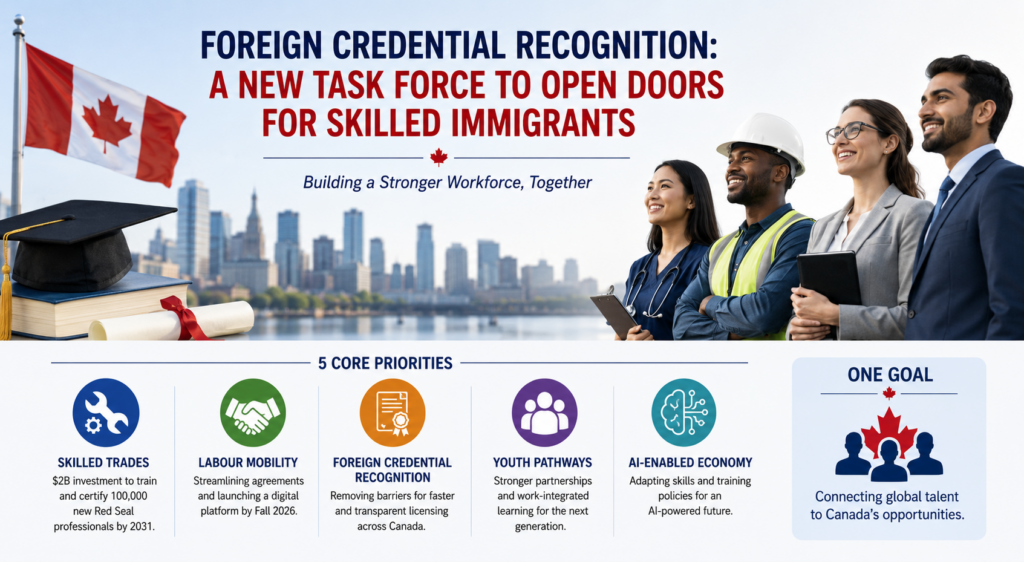
5 Core Priorities Shared by Labour Market Ministers
The recent ministerial discussions established a comprehensive action plan focused on five interconnected pillars designed to strengthen long-term economic growth and enhance workforce adaptability:
- Bolstering the Skilled Trades Workforce: The federal government detailed a large-scale initial investment of $2 billion over five years to expand access to technical training and pre-apprenticeships. This allocation forms part of a broader $6 billion initiative intended to recruit, train, and certify up to 100,000 new Red Seal professionals by 2031.
- Reforming Labour Market Transfer Agreements: Jurisdictions agreed to streamline existing transfer agreements to reduce administrative burdens and optimize results, ensuring that funding allocations keep pace with inflation and rapid population growth.
- Accelerating Foreign Credential Recognition: Ministers prioritized the removal of cross-provincial barriers to make domestic mobility faster and more transparent for certified individuals.
- Improving Youth Pathways: The forum highlighted the need for stronger employer partnerships and work-integrated learning models to help young people enter the competitive job market.
- Adapting to an AI-Enabled Economy: Leaders committed to deepening their technical analysis of how artificial intelligence impacts overall productivity, shifting skills requirements, and training policies.
Streamlining Integration Through Joint Task Forces
A primary outcome of this intergovernmental meeting is the sudden acceleration of initiatives centered on foreign credential recognition and domestic labor mobility. To prevent highly qualified immigrants from facing prolonged career delays upon arrival, ministers authorized the creation of a specialized deputy-led working group. This team is currently tasked with developing ambitious operational measures, including a unified digital platform to coordinate quick employment transitions, with a formal report due by autumn 2026.
Furthermore, the FLMM is actively partnering with the Forum of Ministers Responsible for Immigration through a dedicated Joint Task Force. This specific entity focuses on auditing the barriers encountered by internationally trained professionals at every single stage of their relocation, starting from pre-arrival documentation up to full labor market integration. By addressing licensing delays before a candidate even boards a plane, Canada aims to match incoming talent directly with critical infrastructure projects.
                     CANADIAN LABOUR PRIORITIES FRAMEWORK
                                      │
         ┌────────────────────────────┼────────────────────────────┐
         ▼                            ▼                            ▼
   Skilled Trades             Labor Mobility              Vulnerable Paths
 • $2B technical funding    • Joint Task Force link      • Youth partnerships
 • 100k Red Seal goal       • Fall 2026 digital portal   • AI workforce tracking
Financial Allocations and Strategic Timelines
The execution of these workforce initiatives requires extensive fiscal cooperation and long-term planning across multiple sectors. To visualize how these newly announced resources and administrative updates are distributed, consider the following structural breakdown:
| Strategic Priority Area | Operational Mechanism & Target Outcomes | Funding & Delivery Timeline |
|---|---|---|
| Technical Training Agreements | New bilateral agreements with provinces to expand technical training access. | $2 billion added over 5 years (Starting 2026-27). |
| Red Seal Recruitment | Large-scale recruitment and certification of high-demand trade professionals. | $6 billion framework targeting 2030-31. |
| Mobility Action Plan | Launch of a dedicated digital platform to fast-track interprovincial hiring. | Working group reporting by Fall 2026. |
| Joint Task Force Audit | Pre-arrival and post-arrival cross-checks of credential recognition bottlenecks. | Continuous inter-ministerial deployment. |
Developing a Proactive Immigration Strategy
Navigating these changing economic streams requires a clear understanding of how regional training initiatives impact your individual eligibility. Prospective candidates can review baseline national criteria via the official Government of Canada website or explore general criteria regarding the Express Entry System to evaluate how human capital factors are scored.
To learn how specific provincial rules affect your target destination, please read our dedicated article on Understanding Manitoba Provincial Nominee Programs or read our companion guide on How Foreign Credential Recognition Works. Aligning your initial application with areas receiving active federal and provincial backing remains the most reliable strategy for a successful relocation.
Navigating the complexities of Canadian immigration can be challenging. If you have questions about your eligibility or need assistance with your immigration project, we are here to help. We invite you to contact Mesidor Immigration today for a comprehensive eligibility assessment. Let us be your trusted partner on your journey to Canada.
Search the Site
Latest Immigration News
- Foreign Credential Recognition: New Intergovernmental Task Force to Accelerate Entry for Skilled Immigrants
- Labour Market Impact Assessment: New 2026 Wage Thresholds Drive Critical Shifts in Foreign Worker Recruitment
- Ontario Immigrant Nominee Program: New Priority Stream Opens Essential Pathways

- Refugee Determination: New Bill C-12 Regulations Spark Critical Concerns Over Fairnes

- Immigration Francophone : 20 nouveaux projets gouvernementaux stimulent une croissance historique au Canada

- Francophone Immigration: 20 New Government Projects Drive Historic Growth Across Canada

- L’immigration francophone au Manitoba : 4 mises à jour majeures qui propulsent la croissance

- Francophone Immigration in Manitoba: 4 Major Updates Fueling New Growth

Archives
Subscribe to our Newsletter
Subscribe to our blog and get notified when we publish new posts.
Recent Comments