
Understanding the New Structural Changes for Canadian Employers
Labour Market Impact Assessment (LMIA) requirements are undergoing critical operational updates following the latest regulatory implementation by Employment and Social Development Canada (ESDC). As a Regulated Canadian Immigration Consultant (RCIC) operating Mesidor Immigration in Winnipeg, Manitoba, I regularly help employers navigate these complex procedural frameworks. The mid-2026 updates introduce a refreshed set of provincial and territorial hourly wage thresholds that dictate the exact application stream an employer must utilize.
The classification of a temporary foreign worker position depends entirely on how the offered wage compares to the specific territorial or provincial benchmark. Employers cannot simply pick a stream based on preference; instead, the system enforces a strict mathematical comparison. Understanding these specific regional changes is a vital asset for businesses aiming to recruit international talent seamlessly.
2026 Regional Wage Threshold Matrix
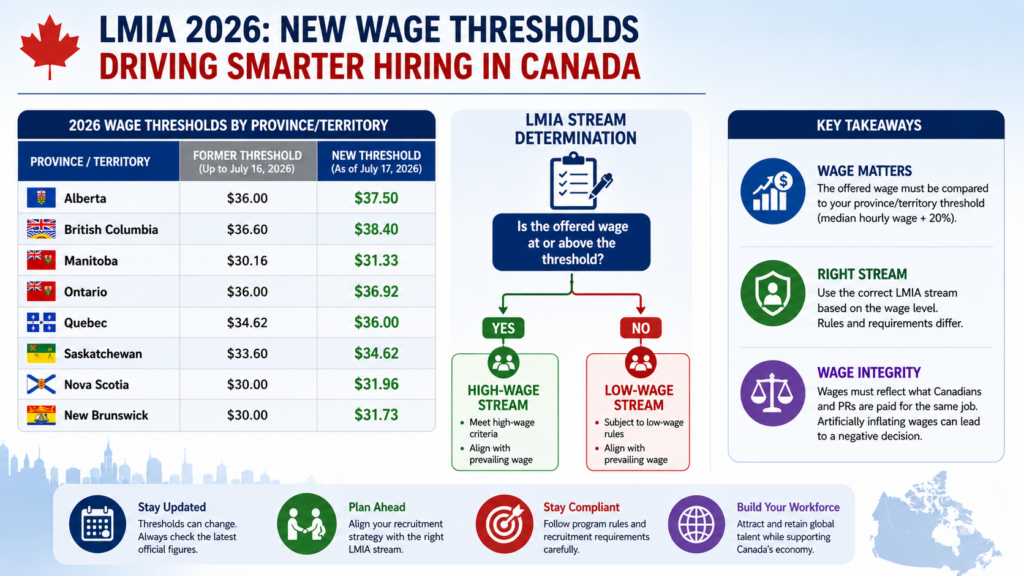
The reference point used to categorize applications is calculated by taking the provincial or territorial median hourly wage and adding 20%. This revised formula establishes a brand-new baseline across the country. Below is the structural breakdown of the updated hourly wage thresholds that apply to all applications received by the government:
| Province or Territory | Former Threshold (Up to July 16, 2026) | New Active Threshold (As of July 17, 2026) |
|---|---|---|
| Alberta | $36.00 | $37.50 |
| British Columbia | $36.60 | $38.40 |
| Manitoba | $30.16 | $31.33 |
| Ontario | $36.00 | $36.92 |
| Quebec | $34.62 | $36.00 |
| Saskatchewan | $33.60 | $34.62 |
| Nova Scotia | $30.00 | $31.96 |
| New Brunswick | $30.00 | $31.73 |
Stream Classification and Wage Consistency Rules
Determining whether an application falls under the high-wage or low-wage stream requires a direct comparison between the offered wage and these active figures. Furthermore, employers must follow specific procedural guidelines to ensure compliance:
High-Wage Stream Requirements
If the hourly pay rate offered on the application sits at or above the designated regional threshold, the business must apply via the high-wage stream. However, simply meeting this financial marker does not guarantee approval. Employers must still fulfill all programmatic criteria specific to this category.
Low-Wage Stream Requirements
When the salary for a position falls below the provincial or territorial boundary, the application must be processed through the low-wage framework. This pathway typically involves distinct caps on the proportion of foreign staff a business can hire, alongside separate recruitment advertising mandates.
Preserving Wage Integrity
Importantly, inflating a salary offer solely to bypass low-wage restrictions is highly counterproductive. The federal government explicitly states that the wages offered to temporary foreign workers must mirror the pay scale of Canadian citizens and permanent residents. The review process evaluates whether the compensation aligns with the local prevailing wage for that occupation, factoring in specialized skills and years of experience. Artificially adjusting the numbers to fit a particular stream frequently results in a negative decision.
                       LMIA STREAM DETERMINATION PROCESS
                                       │
                Is the offered wage at or above the threshold?
                                       │
                ┌──────────────────────┴──────────────────────┐
                ▼                                             ▼
               YES                                            NO
                │                                             │
      High-Wage Stream Stream                       Low-Wage Stream Stream
  • Meet high-wage criteria                     • Subject to low-wage rules
  • Align with prevailing wage                  • Align with prevailing wage
Designing an Effective Workforce Strategy
Navigating these regulatory adjustments demands careful planning from Canadian business owners. Aligning your internal corporate recruitment strategy with the correct operational stream prevents costly processing delays. Beyond temporary staffing, employers can also explore long-term retention options via the federal Express Entry System or look into alternative provincial nomination pathways.
To discover how these federal updates interact with localized systems, feel free to read our comprehensive overview of the Manitoba Provincial Nominee Program or browse our practical insights on How Foreign Credential Recognition Works. Ensuring full alignment with active regional statistics remains the most effective method to secure key international talent for your operations.
Navigating the complexities of Canadian immigration can be challenging. If you have questions about your eligibility or need assistance with your immigration project, we are here to help. We invite you to contact Mesidor Immigration today for a comprehensive eligibility assessment. Let us be your trusted partner on your journey to Canada.
Search the Site
Latest Immigration News
- Foreign Credential Recognition: New Intergovernmental Task Force to Accelerate Entry for Skilled Immigrants

- Labour Market Impact Assessment: New 2026 Wage Thresholds Drive Critical Shifts in Foreign Worker Recruitment
- Ontario Immigrant Nominee Program: New Priority Stream Opens Essential Pathways

- Refugee Determination: New Bill C-12 Regulations Spark Critical Concerns Over Fairnes

- Immigration Francophone : 20 nouveaux projets gouvernementaux stimulent une croissance historique au Canada

- Francophone Immigration: 20 New Government Projects Drive Historic Growth Across Canada

- L’immigration francophone au Manitoba : 4 mises à jour majeures qui propulsent la croissance

- Francophone Immigration in Manitoba: 4 Major Updates Fueling New Growth

Archives
Subscribe to our Newsletter
Subscribe to our blog and get notified when we publish new posts.
Recent Comments