An Authoritative Look at Canada’s Shifting Border Enforcement Landscape
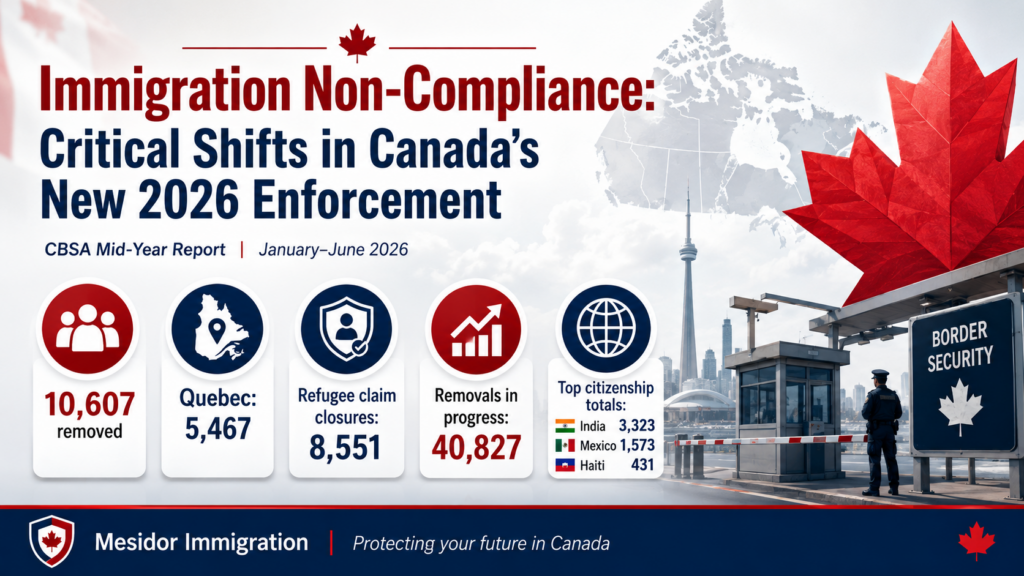
Immigration non-compliance remains a primary focal point for border enforcement operations across Canada, as highlighted by the latest data released by the Canada Border Services Agency (CBSA). On July 24, 2026, the federal government published updated statistics documenting enforcement activities for the first half of the 2026 calendar year. According to the official report, a total of 10,607 individuals who were found inadmissible were formally removed from the country between January 1 and June 30, 2026.
As a Regulated Canadian Immigration Consultant (RCIC) operating Mesidor Immigration in Winnipeg, Manitoba, I understand how alarming these rising numbers can be for temporary residents and applicants navigating complex legal processes. The federal removals program is designed to protect the overall integrity of the country’s immigration programs while establishing procedural fairness for law-abiding applicants. However, understanding the specific grounds and regional trends behind these figures is critical to protecting your own legal status.
4 Crucial Insights from the Mid-2026 CBSA Removals Report
The newly published mid-year data outlines a substantial increase in overall compliance activities nationwide. A closer examination of these figures reveals several distinct patterns that define Canada’s current enforcement priorities:
1. Significant Regional Variances in Enforcement Volumes
The absolute volume of enforced departures varies dramatically depending on the specific administrative region. The Quebec Region recorded the single highest volume of activity with 5,467 enforced removals during the six-month period. The Greater Toronto Area Region followed as the second-most active zone with 2,674 cases. Meanwhile, the Pacific Region oversaw 906 actions, and the Prairie Region—which includes our local communities here in Manitoba—recorded 839 enforced removals.
2. High Concentration of Refugee Claim Closures
A massive percentage of the mid-year totals stems directly from individuals whose protection claims have concluded. Specifically, 8,551 cases involved refugee claimants who exhausted their legal avenues and were found inadmissible under non-compliance provisions. In contrast, non-claimants accounted for 1,303 cases within the same category.
3. Serious Inadmissibility Grounds and Security Audits
While administrative non-compliance represents the vast majority of file closures, the CBSA continues to actively execute orders based on security and public safety parameters. The mid-year statistics show that 624 individuals were removed on explicit criminality grounds. Furthermore, 41 cases involved individuals linked to organized crime networks, and 55 removals were executed due to misrepresentation.
4. Demographics and Removals by Citizenship
The statistical overview indicates that specific national pools account for the largest proportion of overall active files. Indian nationals represented the single largest group with 3,323 enforced departures in the first six months of 2026. Mexican nationals constituted the second-highest total at 1,573 cases, followed by Haitian nationals with 431 completed cases.
                       MID-2026 ENFORCED REMOVALS BY TYPE
                                       │
         ┌─────────────────────────────┼─────────────────────────────┐
         ▼                             ▼                             ▼
Non-Compliance (Asylum)       Non-Compliance (Other)            Criminality
   • 8,551 Cases                  • 1,303 Cases                 • 624 Cases
Understanding Active Inventories and Legal Safeguards
Failing to maintain a valid temporary status or violating the conditions of a visa leads directly to the issuance of a formal removal order. The government utilizes three distinct mechanisms to resolve these cases, including departure orders, exclusion orders, and permanent deportation orders.
To effectively manage these files, the CBSA tracks cases across several distinct operational inventories. For instance, individuals with unresolved legal reviews or pending Pre-Removal Risk Assessments (PRRA) are held within the “Removal not possible” inventory while their human rights are reviewed. The largest growing segment, however, is the active “Removals in progress” inventory, which sits at a grand total of 40,827 cases nationwide. This inventory tracks individuals who are currently being processed for departure as the government collaborates with foreign states to secure valid travel documents.
Maintaining a Lawful Strategy for Your Stay
| Operational Inventory Category | National Statistical Volume | Primary Case Status |
|---|
| Not Yet Actionable | 464,910 Cases | Individuals holding a pending refugee application or recognized refugee status. |
| Removals in Progress | 40,827 Cases | Active files where the CBSA is working to overcome logistical challenges to departure. |
| Wanted Inventory | 33,847 Cases | Individuals who failed to appear for mandatory enforcement or removal proceedings. |
| Removal Not Possible | 32,619 Cases | Open files paused due to active Federal Court appeals or judicial reviews. |
Protecting Your Future in Canada
Proactively managing your status before an administrative issue arises is the single most effective way to avoid facing enforcement measures. Temporary residents can explore stable economic options by reviewing the official Immigration, Refugees and Citizenship Canada website or utilizing the federal Express Entry System to transition into a permanent resident stream.
To discover how provincial regulations can help stabilize your pathway, read our comprehensive guide on Understanding Manitoba Provincial Nominee Programs or read our companion piece on How Foreign Credential Recognition Works. Taking early control of your professional documentation prevents unexpected status lapses.
Navigating the complexities of Canadian immigration can be challenging. If you have questions about your eligibility or need assistance with your immigration project, we are here to help. We invite you to contact Mesidor Immigration today for a comprehensive eligibility assessment. Let us be your trusted partner on your journey to Canada.











Recent Comments