
Understanding Student and Temporary Worker Numbers in Canada: 2026 Data Analysis
Canada’s immigration landscape is undergoing substantial transformation as the federal government works to achieve sustainable immigration levels. Through the Immigration Levels Plan, Immigration, Refugees and Citizenship Canada (IRCC) is making the immigration system more responsive to the country’s needs, with a particular focus on reducing the number of students and temporary workers to help ease pressures on housing, infrastructure, and services. The government has committed to returning immigration to sustainable levels, including reducing Canada’s temporary population to less than 5%.
Dramatic Decline in New Arrivals: The Numbers Tell the Story
Recent data from IRCC reveals a significant downward trend in both student and temporary worker arrivals to Canada—clear evidence that the measures implemented are working effectively.
Student Arrivals Show Sharp Decline
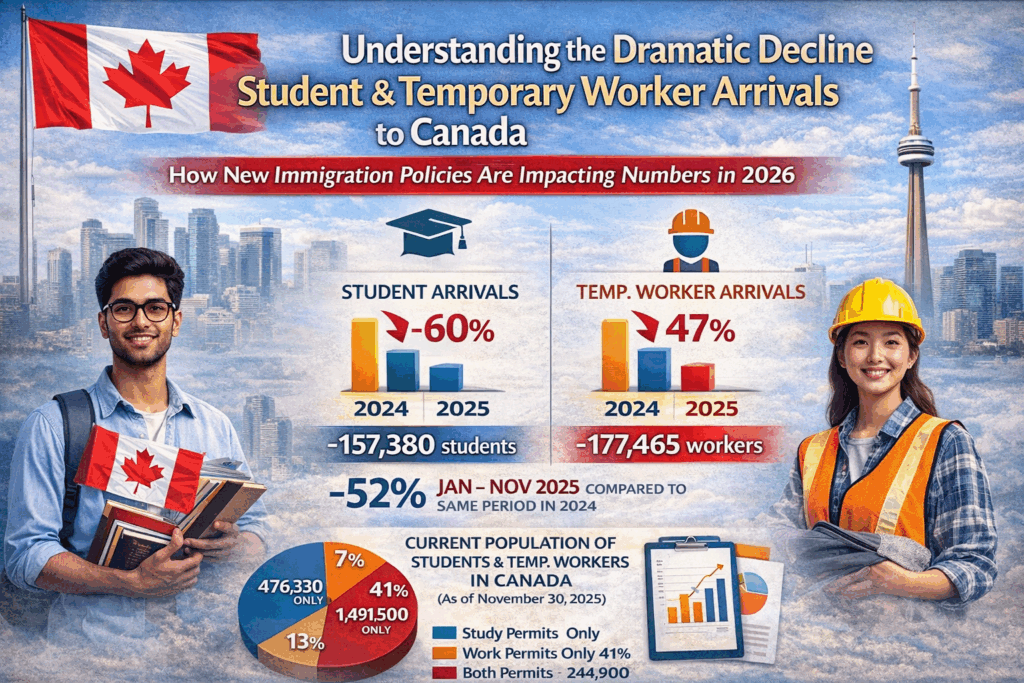
The reduction in international student arrivals has been particularly striking. In November 2025, only 2,485 new study permits were issued, compared to 5,985 in November 2024. More significantly, between January and November 2025, there were 60% fewer new students arriving in Canada compared to the same period in 2024—a reduction of 157,380 students.
The data shows clear seasonal patterns, with larger increases in December and August each year, corresponding to the start of fall and winter semesters at Canadian educational institutions. However, even these traditional peak periods are showing substantial reductions under the new caps.
Temporary Worker Arrivals Also Declining
The temporary worker sector has experienced similarly dramatic decreases. In November 2025, only 13,365 new work permits were issued, down from 21,320 in November 2024. Overall, between January and November 2025, there were 47% fewer new workers arriving in Canada compared to the same period in 2024—a decrease of 177,465 workers.
Combined, new student and worker arrivals to Canada have dropped by 52% between January and November 2025 compared to the same period in 2024, representing a reduction of 334,845 people.
Current Population of Students and Temporary Workers in Canada
As of November 30, 2025, the composition of temporary residents in Canada reflects the ongoing transition toward more sustainable levels:
- 476,330 people hold only a study permit, down from 604,955 in November 2024
- 1,491,500 people hold only a work permit, up slightly from 1,460,510 in November 2024
- 244,900 people hold both a work and study permit, down from 346,340 in November 2024
It’s important to note that while the government has committed to reducing the number of temporary residents in Canada, it takes time for the full effects to appear in the data. This is because inventories of existing applications continue to be processed under the rules that were in place when they were submitted. As a result, more significant effects of the new measures will only start to appear several months after implementation.
Comprehensive Policy Measures Driving the Reduction
Reforms to the International Student Program
The federal government has implemented a multi-faceted approach to manage international student numbers more effectively:
- Annual caps on study permits: An annual cap was introduced in 2024, with further reductions announced for 2025 and 2026 as part of the Immigration Levels Plan for 2026-2028
- Mandatory acceptance letter review: This measure helps prevent study permit fraud and ensures program integrity
- Increased financial requirements: Higher financial thresholds better prepare students for the actual cost of living in Canada
- Planned further reductions: Additional decreases in new student arrivals are planned for 2026-2028
Updates to the Temporary Foreign Worker Program
Significant changes have been made to ensure the Temporary Foreign Worker Program (TFWP) better serves Canada’s labour market needs while protecting workers:
- 10% limit on low-wage hiring: Employers can now hire a maximum of 10% of their workforce through the low-wage stream of the TFWP (20% in certain in-demand sectors)
- Processing restrictions in high-unemployment areas: IRCC stopped processing low-wage applications in census metropolitan areas with at least 6% unemployment
- Increased wage threshold: The minimum wage needed for high-wage roles has been increased, applying these stricter rules to more positions
Post-Graduation Work Permit Program (PGWP) Reforms
The PGWP has been reformed with tightened eligibility requirements to better align the program with immigration goals and labour market needs. These changes ensure that international graduates who receive work permits are well-positioned to meet Canada’s economic priorities.
Restrictions on Spousal Work Permits
Work permit eligibility for spouses of international students and temporary foreign workers has been tightened, reducing the overall number of temporary workers entering through this pathway.
Accelerated Pathways to Permanent Residence
While reducing overall temporary resident numbers, the government is also facilitating permanent residence for select temporary skilled workers already working in Canada in in-demand sectors. This approach helps retain talent while managing overall volumes.
How IRCC Counts Arrivals
Understanding the methodology behind these statistics is crucial for accurate interpretation. IRCC counts arrivals based on the number of people issued study or work permits in a given month. If someone receives both a study and work permit in the same month, they are counted under the study permit group to avoid double-counting.
Several groups are not included in the arrival data:
- Asylum claimants: People who claim asylum in Canada are seeking protection under international law. These claims are not part of planned immigration levels and volumes cannot be directly controlled
- Permit extensions: People who apply to extend their stay are already in Canada and are not new arrivals. Counting extensions would inflate the numbers without reflecting new pressures on housing or services
- Seasonal agricultural workers: These workers are highly targeted and tied to immediate labour shortages, often in rural or remote areas. They typically come for short periods, live in employer-provided housing, and are critical to food supply
- Short-term TFWP workers: Workers under the Temporary Foreign Worker Program who are in Canada for 270 days or less, where the start and end dates fall within the same calendar year, are excluded as they meet immediate labour needs in industries like tourism or construction
Transitioning Temporary Residents to Permanent Status
A key component of Canada’s immigration strategy involves helping temporary residents who are already contributing to communities become permanent residents. From January to November 2025, over 177,000 former temporary residents became permanent residents, accounting for approximately 48% of new permanent residents during that period.
These individuals are typically well-integrated into Canadian society, often possessing:
- Canadian education credentials
- Canadian work experience
- Strong skills in one or both official languages
Most apply for permanent residence through economic programs like Express Entry and the Provincial Nominee Program, which are designed to select candidates who meet Canada’s labour market and regional priorities. By building on the contributions of those already in Canada, the government can continue to attract skilled talent while easing pressures on infrastructure, housing, and services.
What This Means for Prospective Students and Workers
The evolving policy landscape requires prospective international students and temporary workers to navigate a more regulated environment with clearer guidelines and higher expectations:
- Quality over quantity: The government’s approach emphasizes selecting applicants with strong credentials and genuine intentions
- Higher eligibility thresholds: Increased financial requirements and stricter program criteria mean more thorough preparation is essential
- Greater scrutiny of applications: Mandatory acceptance letter reviews and enhanced verification processes require authentic documentation
- Limited availability: Annual caps mean competition for study permits will be more intense
- Regional considerations: Labour market restrictions in high-unemployment areas affect temporary foreign worker applications
Implications for Educational Institutions and Employers
Canadian educational institutions and employers must also adapt to the new compliance requirements:
- Designated Learning Institutions (DLIs): Must demonstrate commitment to supporting international students and maintaining program integrity
- Employers: Must comply with new hiring limits and wage thresholds under the TFWP
- Enhanced accountability: Both institutions and employers face greater scrutiny to ensure they are contributing to sustainable immigration outcomes
Data Transparency and Methodology
IRCC is committed to transparency in reporting temporary resident statistics. All data on the official IRCC webpage is updated as of November 30, 2025, and is approximate and subject to change. To protect individual privacy:
- All values between 0 and 5 are shown as “–” in tables and visualized as zero in graphs
- All other values are rounded to the closest multiple of 5
- As a result of rounding, data may not sum exactly to indicated totals
These measures prevent individuals from being identified when data is compiled and compared to other publicly available statistics.
Looking Ahead: Sustainable Immigration for Canada’s Future
The comprehensive data and policy measures outlined above demonstrate Canada’s commitment to achieving a sustainable immigration system that benefits all stakeholders. The significant reductions in both student and temporary worker arrivals reflect a deliberate strategy to:
- Ease pressures on housing, infrastructure, and social services
- Maintain the integrity of immigration programs
- Protect vulnerable temporary residents from exploitation
- Ensure labour market needs are met through targeted, sustainable pathways
- Provide opportunities for well-integrated temporary residents to become permanent residents
As Canada continues to refine its immigration policies, staying informed about these changes is essential for anyone considering studying or working in Canada. The data clearly shows that while Canada remains welcoming to international students and workers, the pathway now requires more careful planning, stronger credentials, and genuine alignment with the country’s economic and social priorities.
How Mesidor Immigration Can Help
Navigating Canada’s evolving immigration system requires expert guidance and up-to-date knowledge of policy changes. With substantial reductions in both study permit and work permit approvals, the competition for available spaces has intensified significantly. Success now depends on:
- Understanding the latest eligibility requirements and caps
- Preparing applications that meet enhanced scrutiny standards
- Demonstrating genuine intentions and strong credentials
- Timing applications strategically within the new framework
- Exploring pathways to permanent residence for those already in Canada
Whether you’re an international student planning to study in Canada, a temporary worker exploring employment opportunities, or a current temporary resident seeking to transition to permanent residence, professional guidance can make the crucial difference between success and refusal.
At Mesidor Immigration, we stay current with all policy changes and statistical trends affecting Canada’s immigration system. Our experienced team can help you understand your options, assess your eligibility, and prepare a strong application that aligns with current government priorities.
Contact Mesidor Immigration today for a comprehensive eligibility assessment and let us guide you through every step of your Canadian immigration journey in this new era of sustainable immigration management.

- EMAIL: im*********@*****or.ca
- PHONE / WHATSAPP: 204-898-8510
Search the Site
Recent Immigration News Posts
- Foreign Credential Recognition: New Intergovernmental Task Force to Accelerate Entry for Skilled Immigrants

- Labour Market Impact Assessment: New 2026 Wage Thresholds Drive Critical Shifts in Foreign Worker Recruitment
- Ontario Immigrant Nominee Program: New Priority Stream Opens Essential Pathways

- Refugee Determination: New Bill C-12 Regulations Spark Critical Concerns Over Fairnes
- Immigration Francophone : 20 nouveaux projets gouvernementaux stimulent une croissance historique au Canada

- Francophone Immigration: 20 New Government Projects Drive Historic Growth Across Canada

- L’immigration francophone au Manitoba : 4 mises à jour majeures qui propulsent la croissance

- Francophone Immigration in Manitoba: 4 Major Updates Fueling New Growth

- Understanding Student and Temporary Worker Numbers in Canada: 2026 Data Analysis

- Thunder Bay Forward: Immigration Opportunities in Northern Ontario Through 2030

- Yukon Nominee Program 2026: Critical New Updates That Employers and Foreign Workers Must Know

- Refugee Protection Claims Reach Critical High: 5 Major Trends for 2026

- Canada’s Immigration Selection Model: Recent Changes and Expert Perspectives

- Programme pilote d’immigration dans les communautés francophones (PPICF) : Une nouvelle voie majeure pour les francophones

- New Citizenship Rules for Canadians Born or Adopted Abroad: What You Need to Know

Recent Comments